Josephine was an iconic dancer, singer and entertainer. She was the first African American woman to star in a motion picture, to perform with an integrated cast at the American concert hall, and one of the first African American entertainers who achieved acclaim both in movies and on the stage.
Born in June in America, Baker danced in several Vaudeville shows and was part of the Harlem Renaissance in the 1920s. She performed in Broadway chorus lines such as Shuffle Along before moving to Paris aged 19 where her career thrived.
She dazzled audiences by dancing the Charleston for the first time, symbolizing for some the potential liberation of women in a period when clothing had become looser and movement less inhibited. Her performances at the Théatre des Champs-Elysées (a venue which remains open today) cemented Josephine’s status as an artist and style icon.
Her emergence as a dancer and performer helped define and shape the spirit of the “jazz age” in the capital. Her headline performances at the Folies Bergère in Paris (a club still open today) were renowned, including her Danse Sauvage of which she said:
“I wasn’t really naked. I simply didn’t have any clothes on“.
This is where Josephine debuted her iconic “banana skirt” in 1925, as part of a new show titled La Folie du Jour.
In 1930 Josephine debuted what was perhaps her most successful show, entitled Paris qui Remue. It featured a live cheetah named Chiquita and saw her debut her hit song ‘J’ai deux amours’. Proceeds from the show were donated to charities including the Red Cross.
During the 1950s, Baker returned to the United States and supported the Civil Rights Movement boycotting segregated clubs and concert venues. Because of her criticisms she was accused of being a communist sympathiser which resulted in her US work visa being rescinded. She would not return to the US for over a decade.
Not only was she an incredible performer, she was also a French Resistance agent, for which she was awarded the Croix de Guerre and the Legion of Honour.
In 1974 she would perform in the Royal Variety Performance at the London Palladium. Josephine sadly passed away the following year during the celebration of the 50th anniversary of her Paris debut.
At her funeral, military officials performed a 21-gun salute– the first such honour to have been given an American woman laid to rest in France. France and Parisians have gratefully adopted her in turn as their own, and she has left a deep imprint on the city and its cultural history.
We first developed our anti-racism and education actions in March 2021. In the two years since we have learned so much. We have focused on our rooted dance practice by further honouring the dance’s history. We also started to integrate anti-racist approaches to our troupe’s governance, initiatives and goals. We still have so much to learn.
Our BLM, Education and History subgroup have been reflecting on our initial actions. What has become evident is that while we can focus on improving our cultural appreciation as a troupe, the context of the wider scene in which we dance has cultural appropriation and structural racism deeply ingrained. For this reason, our updated actions focus on harm reduction. This means both reducing future harm, and redressing past harms.
Our updated actions will help us to keep moving forward and keep us accountable.
Action 1: Learn the history of the dance’s movements and musical connection in order to preserve the original spirit of Jazz. Our troupe leaders teach sessions which explore and celebrate the pioneers in Vernacular Jazz. We study historic clips of dancers, singers and musicians. We also develop our rooted Jazz disciplines such as musicality and improvisation. We will continue our history education during our practice sessions to honour and appreciate African American Jazz culture.
Action 2: Share how our education is influencing our dance practice. We wish to share our Jazz roots education and inspirations with the wider community, inviting everyone to join us in our learning. We will do this by sharing our practice and what we have been studying during rehearsals on our social media channels.
Action 3: Share educational resources and research on Black female Jazz artists through history. It is important to us as a femme troupe to spotlight Black women in Jazz history who are so often sidelined or erased. We are developing a project to share with the swing dance community which will celebrate the lives of Black female Jazz artists.
Action 4: Build on our internal resource on the dance’s history that troupe members can collaborate on and refer to at any time. We will continue to share anti-racist, history resources with each other on our private Facebook group. This is an important part of our engagement with cultural appreciation for every troupe member.
Action 5: Donate regularly to Black community groups. We donate 10% of our troupe members’ subscriptions to support Black community groups. In 2023 we will be selecting two new charities to support, one national and one international, giving 5% to each. We do not see this as a charitable donation, but as part of our wider commitment to reducing harms caused by structural racism.
Action 6. Curate useful anti-racist and BLM resources from within the swing dance community. Sharing information on the dance’s history and anti-racist discussions within the dance scene today, we can help to reduce harms caused by the erasure of Jazz’s West African roots. Our website’s Resources page links to anti-racist arts organisations and discussions from the swing community. It also links to history resources available in books, articles, podcasts, and Instagram accounts. We will continue to add to this valuable resource page.
Action 7. Make conscious choices about the music we perform to, and the events we attend. Who we promote and celebrate matters. To be mindful of the ways in which we can avoid our involvement with cultural appropriation within the swing dance scene, we will be asking a number of questions when choosing music and events.
What are the values of the musicians playing the songs we perform our routines to? What are the values of the event organisers, and the invited teachers and performers? What are the power dynamics at play at the event? Who benefits financially from the event? Is the artist or event taking steps to reduce instances of cultural appropriation?
Action 8. Identify and implement ways to create a welcoming and inclusive space for people of all backgrounds. Creating a safe and welcoming troupe involves focusing on equity and harm reduction. Our decisions on where to compete or perform will always prioritise the safety of our troupe members. We do this to prevent harms to physical and mental health caused by racism, sexism, homophobia, transphobia, ableism and any other form of discrimination. We will continue to offer discounted membership rates to troupe members who face financial hardship.
Action 9. Invite guest teachers from dance disciplines rooted in African American Jazz or Dance of the African Diaspora (DAD). Broadening our dance practice is very important to us, as is celebrating dance teachers who share our values. We will aim to invite two guest teachers a year to our practice sessions.
In 2021 we published our anti-racism and education statement along with 8 actions. The aim of these actions is to hold us accountable to our statement. We have learnt so much over the past two years, and of course are still learning how best to honour the history and culture of Vernacular Jazz, and expand our rooted dance practices. Here’s an update on how our actions have been going.
Action 1: Initiate a BLM and anti-racist education subgroup within our troupe.
How is it going: Completed We have set up a BLM, Education and History subgroup and they have been a driving force behind our anti-racism actions below. They have a great project in the pipeline for 2023, we can’t wait to share it with you!
Action 2: Learn the history of the dance’s movements and musical connection in order to preserve the original spirit of Jazz.
How is it going: Initiated and Ongoing Our troupe leaders have been teaching sessions which explore and celebrate the pioneers in Vernacular Jazz. We have been studying old clips of dancers, singers and musicians, as well as developing our rooted Jazz disciplines such as musicality and improvisation. Since we set these actions, we have studied the movement of Nikki O’Daniel, The Sepia Steppers, Mabel Lee, Marie Bryant, John Bubbles, Al Minns and Leon James, as well as performances from Soundies such as The Lonesome Road (1941), Block Party Revels (1943), and Carolina Blues (1944). In 2023 we will continue our history education during our practice sessions.
Action 3: Create an internal resource regarding the dance’s history that troupe members can collaborate on and refer to at any time.
How is it going: Initiated and Ongoing We have created an internal resource for our troupe on our private Facebook group, compiling all our resources using the hashtag #jazzrootsstudygroup. Our team members have been sharing clips, articles, podcasts, and panel discussions related to the history and culture of Vernacular Jazz. In 2023 we will continue to share interesting anti-racist, educational resources with each other.
Action 4: Donate regularly to Black community groups in and around Newham (London).
How is it going: Initiated and Ongoing We will update this pledge as we are no longer based in Newham. This past year we have been donating 10% of our members’ subscriptions to IRIE! Dance Theatre, who aim to heighten the profile of Black dance in Britain. In 2023 we will be selecting two new charities to support.
Action 5. Share educational resources and research on Black female Jazz artists through history.
How is it going: Initiated and Ongoing In 2022 we focused on spotlighting Ella Fitzgerald, publishing new public posts on Instagram and our website, along with two community performances to Ella songs (one on the week of her birthday). We have made sure all our previous ‘History Spotlight’ Instagram stories are available as highlights on our profile. In 2023 we are developing a project to share with the Swing Dance community which will celebrate the lives of Black female Jazz artists.
Action 6. Curate useful anti-racist and BLM resources from within the Swing Dance community.
How is it going: Initiated and Ongoing Our website now has a Resources page which links to anti-racist arts organisations and discussions from the Swing community, and to history resources available in books, articles, podcasts, and Instagram accounts. In 2023 we will continue to add to this valuable resource page.
Action 7. Identify and discuss problematic vintage songs and words
How is it going: Initiated and Ongoing We’re always keeping this in mind, learning the origins of dance moves and why they are named (or renamed) the way they are during our practice sessions. In 2023 we will merge this action into Action 3 and Action 6.
Action 8. Identify ways to improve our troupe’s diversity.
How is it going: Initiated and Ongoing We have been working to remove barriers that may prevent some people from being able to join the troupe. This included offering scholarship or discounted membership subscriptions during our last auditions. We’ve also been making sure our decisions on where to compete or perform prioritise the safety of our marginalised troupe members. In 2023 we will be working on community building by initiating a new Swing Community subgroup. This group will find ways to positively engage with wider Swing Dance communities, both as a team and as individuals.
We plan to create an updated list of actions to keep us moving forward with our anti-racism and education pledge, and will publish the new actions list in March 2023.
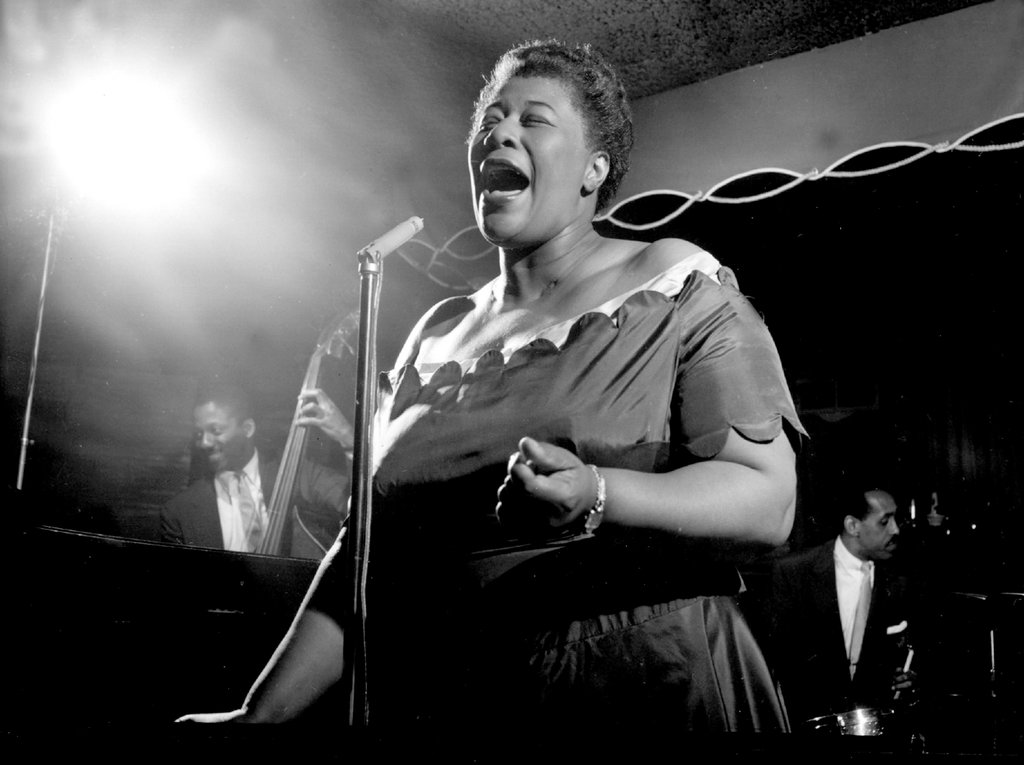
Known for her rich vocal talents, Ella was and is an incredibly inspiring woman. Ella inspires us because of her pure love for her art, her extraordinary ability to improvise both rhythmically and melodically and her ability to break down barriers.
Born 25th April 1917, Ella was a jazz enthusiast from a young age. She idolised Connee Boswell of the Boswell Sisters, often trying to recreate her sound.
After her mother’s death in 1932, Ella moved to Harlem to live with her Aunt.
She won the top prize of $25 singing at the Apollo Theatre’s Amateur Night in 1934, aged seventeen. Ella had initially entered as a dancer but opted to sing last minute after seeing the previous dance act duo, The Edwards Sisters. It was here that she captivated audiences with her rendition of Hoagy Carmichael’s ‘Judy’ and the Boswell Sister’s ‘The Object of My Affection’. Although notoriously shy, reserved and self-conscious, Ella found her home in the spotlight.
The following year, Ella won the chance to perform with the Tiny Bradshaw band at the Harlem Opera House, where she was introduced to bandleader Chick Webb.
She joined Chick’s band and they performed all over the USA but are most associated with the Savoy Ballroom in Harlem. After Chick’s death in 1939, the band was renamed Ella and her Famous Orchestra where Ella took on the role of bandleader.
Her other collaborations included Louis Armstrong, Duke Ellington, Count Basie, Nat King Cole, Frank Sinatra, Benny Goodman, and The Ink Spots.
Ella became the first African American woman to win a Grammy Award, and went on to win 13 more, including the Grammy Lifetime Achievement Award in 1967. Her chart-topping number 1. hit version of A-Tisket, A-Tasket (1938) was entered into the Grammy Hall of Fame. The song was performed in the film “Ride ‘Em, Cowboy” (1942) in which Ella is riding a bus asking fellow passengers if they’ve seen her yellow basket. In the scene she is sitting at the back of the bus, one of the many discriminatory racial segregation rules in America at the time.
Civil Rights Activism
Ella was a civil rights activist, using her talent to help break racial barriers across the USA.
She was recruited to join the Jazz at the Philharmonic (JATP) tour in 1949, with racially integrated bands. The tour targeted segregated venues where tour producer and promoter, Norman Granz (who was also Ella’s manager), told the venues the shows would be cancelled if there was segregated “coloured” and “white” seating. He ensured Fitzgerald received equal pay and accommodations regardless of her sex and race.
“Maybe I’m stepping out (of line), but I have to say it because it’s in my heart. It makes you feel so bad to think we can’t go down through certain parts of the South and give a concert like we do overseas and have everybody just come to hear the music and enjoy the music because of the prejudiced thing that’s going on.
“I used to always clam up because you (hear people) say, ‘Oh, gee, show people should stay out of politics.’ But we have travelled so much and been embarrassed so much. (Fans) can’t understand why you don’t play in Alabama, or (ask), ‘Why can’t you have a concert? Music is music.’”
“I owe Marilyn Monroe a real debt. It was because of her that I played the Mocambo, a very popular nightclub in the ’50s. She personally called the owner of the Mocambo, and told him she wanted me booked immediately, and if he would do it, she would take a front table every night. She told him – and it was true, due to Marilyn’s superstar status – that the press would go wild.
“The owner said yes, and Marilyn was there, front table, every night. The press went overboard. After that, I never had to play a small jazz club again. She was an unusual woman – a little ahead of her times. And she didn’t know it.”
Ella Fitzgerald
In her later years, Ella established the Ella Fitzgerald Charitable Foundation in 1993, which is still helping people to this day. The charity awards grants in four major areas which were important to Ella:
Creating educational and other opportunities for children
Fostering a love and knowledge of music, including assistance to students of music
The provision of health care, food, shelter and counselling to those in need
Specific areas of medical care and research with an emphasis on Diabetes, vision problems and heart disease
Her many other awards include the NAACP’s Merit Award and Image Award for Lifetime Achievement, the National Medal of Arts, and the Presidential Medal of Freedom.


 The London Starlings